Gender Differences

photo 1-2


photo 2-2


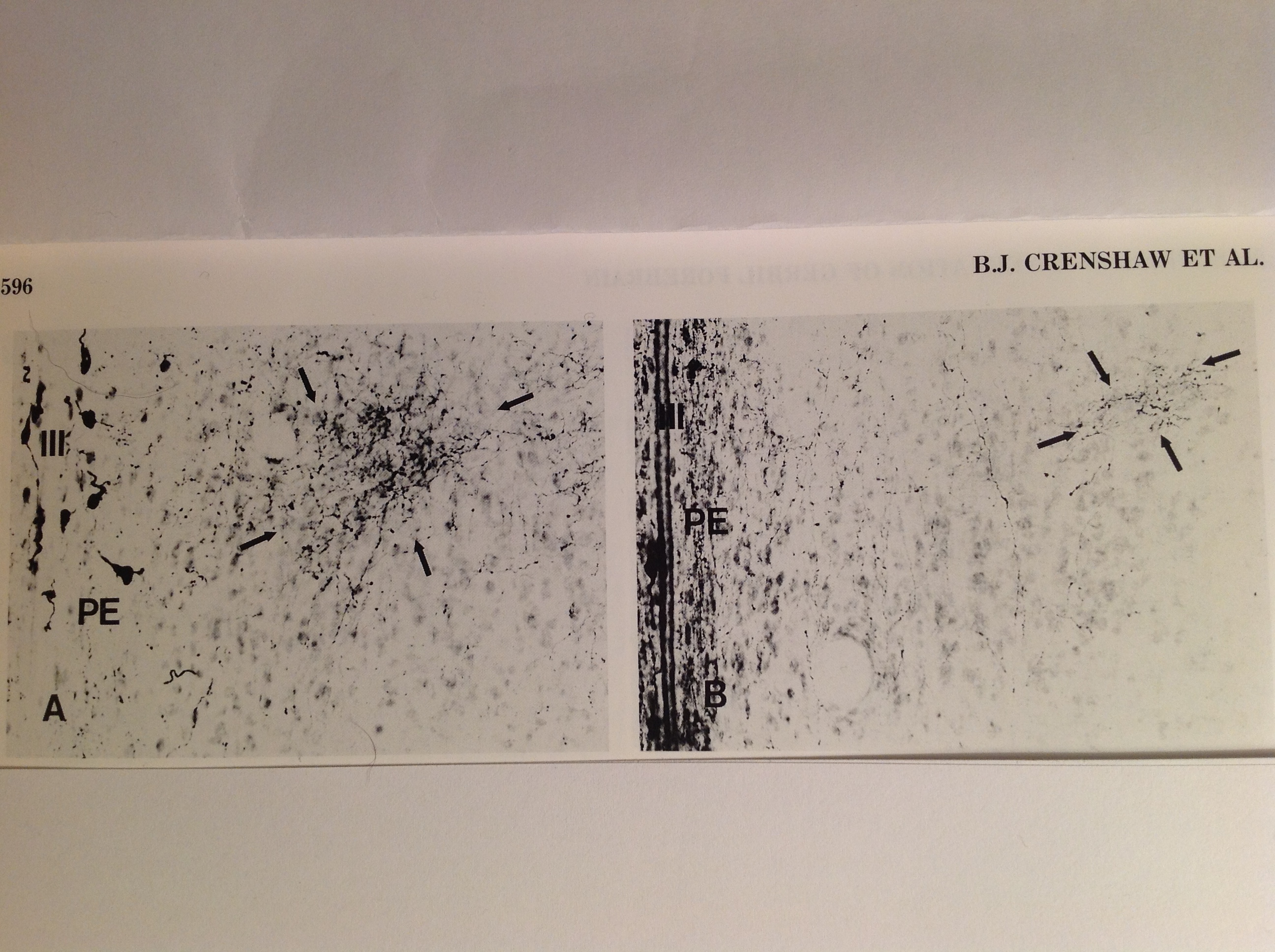
I’d like to be unorthodox, and propose a choice: you can bear with me for a minute and let me explain what these pictures are about, or you can skip to the George Carlin quote in paragraph 7, whereupon this article might appear more overtly crafty. Or at least more conventionally organized.

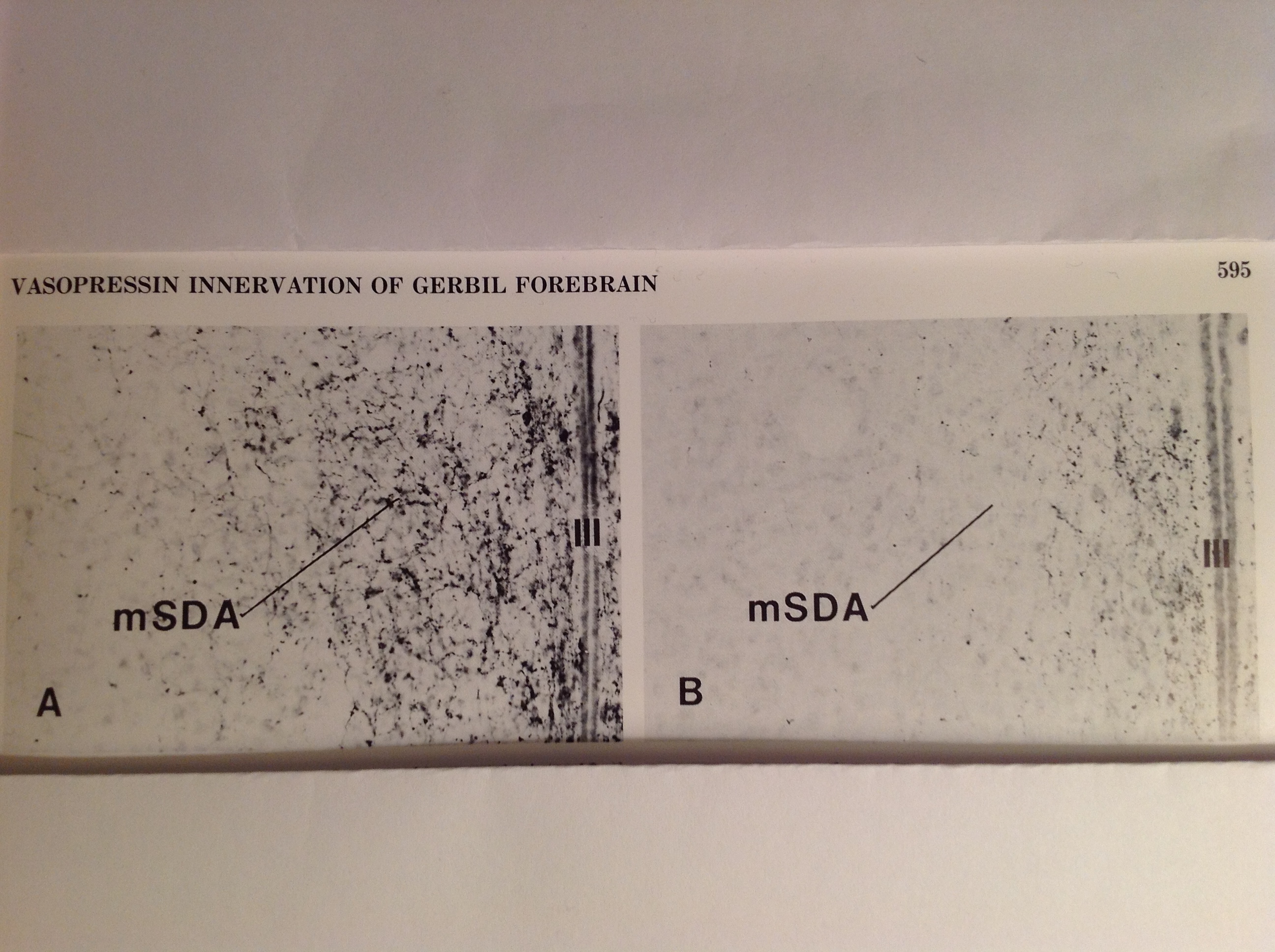
But if you do that, you’ll want to come back to these photographs anyway: they display a region in the brain called the medial pre-optic area, which is a locality involved in, among other things, the expression and regulation of various important hormones— which in turn regulate various important behaviors you’ll probably want to know about. The brain sections shown here are from a gerbil–actually, two gerbils: a male and female. I took these pictures during my years in training in a neuroscience laboratory, where my lab mates and I were pursuing neuroanatomical differences between the two genders. The top picture depicts the medial Sexually Dimorphic Area (mSDA) of a male (on the left) and female (on the right) brain. The bottom picture depicts the SDA pars compacta (SDApc) of a male (on the left) and a female (on the right) brain. At the time they appeared some 22 years ago in The Journal of Comparative Neurology, these pictures and others like them caused discrete but obvious excitement among neuroscientists–who as a group are turned on by the most unlikely things.

The source of the excitement were those differences visible in the neuroanatomy between the two brains–the male and the female. Anyone can see them, which is the point of these pictures. The black irregular dots, lines and smudges densely evident in the male brain are neurons and interconnecting tracts full of vasopressin. Males have a considerable amount of these neurons in these brain areas, and females have comparatively little. Such differences were first discovered by my lab director in a set of studies in 1982–and so for the first time evidence was found to indicate that there were structural differences between male and female neurology.

This was a big deal. Given the materialist way that scientists think, to locate a difference in the brain meant that they could locate the source of differences in behavior. This is of course an axiomatic belief in science and medicine. The great longing is to connect an underlying neurological structure (basal ganglia, let’s say) and its resulting behavior (Parkinson’s disease, for example). Once a correlation can be established, then the next step is to create a technology that can repair the brain, and thereby change, in this case, the deteriorations of the Parkinson symptoms. We could save Michael J. Fox (among all the other people suffering with the disease). There are many diseases we are all familiar with–Alzheimer’s disease, Multiple Sclerosis, Parkinson’s, Schizophrenia–that are studied under this primary conceptual model of brain/behavior research.

Now with that in mind, the pictures above show a brain area that is involved in other pretty interesting behaviors, among them aggression, stress responses, parental behavior, and the really big one: sexual behaviors. And not too long after the work in our lab was published, a gentleman in a lab in San Diego claimed to have found an analogous structure in human brains, which he pronounced as the source for homosexual behaviors. You maybe can grasp the initial excitement of that discovery. All sorts of godly people were clamoring for follow-up research that would allow surgical interventions in the brains of gay men to relieve them of their unChristian urges–techniques that would allow that nucleus to be ablated without actually killing the poor sinner whose brain they wanted to tweak so they could control the nature of his desire.

In the nick of time, it was discovered that the brain area found in the human beings studied in that one lab could not be found in other human brains by other scientists in other labs, which suggested that this purported homosexual nucleus was merely an artifact of the immunocytochemistry used to stain for it in San Diego. Much of the Republican world wept in consternation. About this same time, other scientists announced related findings that somehow had, until that time, escaped their detection: human sexual behavior is really really complicated. Naturally, other corollary discoveries soon followed: there is no end to the number of brain areas involved in sexual behavior, including those also involved in violence and aggression, and there certainly is not one tiny nucleus hidden somewhere that governs everything.

There was at that time at least one young scientist (i.e. me) who thought that this hope for a solitary place in the brain that governed everything should have passed out of common belief after Descartes picked the pituitary gland as the resident palace of the soul. That was in the 17th Century, after all, and I had thought the whole project would have been abandoned after 3 futile centuries. But, no, there remains an interest in material explanations to account for the differences between genders–an abiding fevered energy pursuing why, as George Carlin observed, “Women are crazy, and men are stupid.”

Carlin has, to my way of thinking, an especially poignant way of articulating the observed differences, and he is equally memorable regarding the conclusions he reached about the source of those differences: “Women are crazy because men are stupid“. Well, yeah, he was on to something, though I suspect that he derived his hypothesis by taking into account other sources of evidence than looking at the brain cells of gerbils.

There are plenty of them–other sources, I mean. And in the spirit of George Carlin, let’s look at, oh, maybe one random example: the recent movie Her. In this film, for those of you who may not have seen it, we follow a sensitive male in the person of Theodore Twombly, who makes his living writing love letters for other less articulate males–those who are tongue-tied, who are less in touch with their sensitivities, and need help. Theo is a contemporary Cyrano de Bergerac, eloquently seducing women for the pleasure of dumb, under-socialized, but physically attractive men. He himself has had his own successes with at least one woman, which regrettably proved temporary: his marriage to her failed. And therefore, with the logic of a precocious fifteen-year-old, he decides to have telephone relationships with other women, with whom he does not actually need to talk, except insofar as they try to bring each other to sexual climax by referring to their dead cat fetishes.

In the end, that doesn’t work for him any better than his marriage did, though the cause of the failure did not turn out to be what I expected. His problem is not that the whole relationship is a fantasy conducted over a telephone, but rather that it is still engaging, however weirdly, with an actual person. Even on the telephone Theo is constrained to interact with an individual different than he is, with likes and sources of satisfaction other than those he would prefer.

Therefore, with movie wisdom he discovers his true love in Samantha, who is a virtual intelligence that sounds like Scarlett Johansson (and not like Phyllis Diller, which is lucky), and is constructed to fulfill his every wish. She is smart, entertaining, subservient to the nature of his interests, available at all hours of the day and night, adjusts to his sleep and work schedules, and admires the way he thinks. She even concocts a considerate plan for sex, using a physical woman hooked up through ingenious blue tooth devices to the computer, so that Theo might have an actual consummation with an actual physical being, who in turn is electrically connected to the cyberlife of Samantha. What could go wrong?

Well, let me tell you I have yet to find a single woman I know who has been remotely seduced by the premises of this ideal. Of course, from the point of view of science, my female sample is merely anecdotal evidence, but the logic of their friendly complaint seems to me to bear the weight of generalization. The guy in the movie wants his own romantic illusion, which is too much of a mirage even to allow the electronic succubus as a possible erotic evolution to his connection to Samantha. He only wants exactly what he wants, and only by his own terms. No blemishes, no human smells or fluids, no hair, no independence. Eventually, even the artificial intelligence is smart enough to leave him before things go too far, and he imagines some coercive means to compel her to fit his ideas of a soul mate. Fidelity appears to be one of them, since he is crushed by the disclosure that Samantha has been ‘mating’ 600-and-something other men. We can almost hear Othello lamenting in the background “that we can call these delicate creatures ours, and not their appetites.

Theo as Everyman prefers to keep his ideals remote, and unhampered by materials he cannot control. Which is a problem in real life, where most of us have to reside, since any attempt to import them into the daily round of experience is bound to be frustrating, disappointing, aggravating. They have no relationship to reality, which simply refuses to behave according the way men have wanted it to act. Naturally, a certain percent of males will want to do something about that–say, for example, drive through parts of the UC Santa Barbara campus and shoot all the blonde women who wouldn’t have sex with them–whom they didn’t actually know, never actually tried to relate to, but only stood in for their ideal. The male preference has always been to prefer the idea, and compel the material world to accommodate to it. And the social world, the political world, the religious world, and every other world that males have populated. Hence the truth value of Carlin’s category, “Men are stupid.”

I won’t presume to indicate what crazy thing women might prefer, except to note that thus far it has not included shooting all the blonde men they know, or taking assault weapons into elementary schools to massacre all the children, or even making bombs out of horse manure and use them to blow up Oklahoma day care centers. Those decisions remain the province of masculine choice and action, guided by a masculine version of idealism. As our generals told us during the Vietnam War, we have to destroy the village to save it. These separations in behavior between men and women are startling, or at least I find them startling. Here we have a set of behaviors—or perhaps a proclivity for a set of behaviors—that distinguishes the members of the stupid group from those in the crazy group.

Wouldn’t it be interesting to identify the basis for those differences? Doesn’t it seem important? That’s what led me into the laboratory in the first place, where I took those photographs. Just like any other male, I was inclined to pursue an ideal to its logical conclusion—though in my case I neither had an interest in virtual women like Theo, nor a desire to change someone’s brain surgically to alter his sexual orientation, to alter his concept of beauty. Instead, I had my own proclivities—let’s call it my own inclination to look into the male brain, identify the region of violent sociopathy, and remove it. It sounds like such a good idea on paper, at least from the point of view of a masculine call to direct intervention. Ideas like this always look good in theory to somebody hunting after the definitive remedy, the perfect fix, the final solution.

I probably at this point should confess that I am still male, and still can be fooled by my logical extremities. So you probably shouldn’t take everything I say to heart. Besides, I am not the materialist I used to be. I’ve given up the idea that we can fix evil by materially removing the source of it from the brain. Some new pill won’t work either, though that isn’t stopping the pharmaceutical industry from imagining further expensive medicines to try on our children. It’s not going to go away.

Evil isn’t, I mean, evil won’t be going away any time soon–though maybe our unarmed, idealistic women have counsels to offer, or proposals to counter male ideas about material domination. It’s possible. Let’s go ask them.
My Life With Skunks

A friend of mine–Bruce–had a pet skunk that he kept in his apartment, where it was about as house-trained as a cat. It had its own kitty litter thing in the bathroom, and we would feed it raw hamburger and eggs, and it was relatively affectionate like cats sometimes are. Occasionally at night, though, it would get territorial with Bruce’s new friends coming over to visit, and at such times it would stamp its little feet in a cute way, then spray you in the face with this incredibly foul, noxious fluid that would burn your eyeballs out. Then we would all live on the beach for a couple of weeks until the apartment aired out. That’s how we rolled in Southern California in those days. We were pretty laid back.

I mention this as prologue to the afternoon years later, when my beeper went off, and I was paged to the ER to evaluate an adult who had just been brought in by ambulance. My office was in another part of the hospital, and while I was walking through the corridors I was reminded of my sunny adolescence as I met the unmistakable essence of skunk rolling like an awful fog up the hallway. Once I arrived in the ER, I didn’t need anyone to point out who I was supposed to be evaluating–which was a good thing, really, since the place was pretty much empty: patients, doctors, family members, nurses, social workers, orderlies, receptionists–everybody had cleared out.

Except two unhappy EMT’s from the ambulance, and this emaciated guy wearing a sort of breech clout and vest that he obviously made himself out of maybe a dozen skunk skins. He hadn’t tanned them, so of course they were rotting (this was September, the end of summer), which only added to the flavor of the encounter. It was memorable. The first thing I did was order the three of them outside into the courtyard, and tried to get up wind of him. I wasn’t worried that he would try to escape: there was no place on earth he could hide, and besides, you could see he was starving. It’s true he was also floridly psychotic and paranoid, but he was tamed by the lethargy induced from his long want of food. He was actually in a bad way.

He had spent months out in the woods, and the woody terrain bordering the farmland of a nearby town. It turned out that everybody knew he was out there: farmers spend a lot of time outside in the summer looking at their crops, the weeds, the weather, rain clouds and so on, and folks noticed this young man in various stages of nakedness roaming around in the miles and miles of forested countryside. He wasn’t harming anyone, and so in the egalitarian way of stoic New Englanders ever since Robert Frost, they let him do his thing. Also, they were really busy this time of year.

Whatever crazy, fearful thinking first led him out into the woods, after he was there a while the most important thing on his mind became food. It is hard for a person in a disorganized, disheveled mental state to find and capture enough edible materials–whether animal or vegetable–to keep his body sound for months on end. The only things that he could find to eat, and that would not try to run from him, were the skunks. They don’t run: they stand their ground and warn everything else to get away, fast. So he could kill and eat skunks–and then after his fashion, he made clothing from their hides once he lost whatever he was wearing when he first left his civilized mind in whatever place he once called home.

I suppose it’s true everywhere, when you think about it, but in the part of New England I’m talking about, skunks are in finite supply. There’s just not that many of them,
not enough to support a large and clumsy predator forever. So after he had killed and eaten all the skunks he could find, the only other thing that wouldn’t run away were the cows out in the pastures. It must have taken a while for him to figure out how to attack a cow, or to get hungry enough to try, but he eventually shot one with a bow and arrow he got somewhere, and that was too much for the area dairymen, who had a tough enough time trying to make a living without having people shoot their best milkers with toy arrows. One of them called the police, and that in the due course of events led to my chance to meet him. It was as natural as breathing: find someone in skins shooting arrows at cows, and bring him to the Emergency Room to see me. I’ll sort things out.

This time, however, I wasn’t given a chance. No community can afford to have its ER shut down, so while I was outside with him, a team of people with a large van came to collect him and bring him to New Haven, where there were facilities that could handle the particular challenges my guy presented. They bundled him up in some sort of cloaking fabrics, and off they went. I never saw him again.
POSTSCRIPT

Over dinner one night I mentioned the encounter to a friend of mine, Gary Young, who was as moved as I have been by the passions stirring my scared hunter. So Gary wrote a poem, which is published on page 225 of his book, Even So: New and Selected Poems. You can also read it here (It is a prose poem):

In Western Massachusetts, a man wandered into the woods to live alone. He tried hunting, but the only animals that stood their ground, the only animals he could catch were skunks. The man was sprayed, of course, but he caught them, ate them, and dressed in a cloak of rancid pelts. When he was found, the scent was on his breath, his skin, and when I heard his story, I thought, comrade.

The Death of Garcia Marquez

IMG_1357

When Garcia Marquez died recently, he took with him not only the whole of his life, but a major portion of my own life as well into whatever absent world he entered in death. If I had known in time that his dying was imminent, I would have given him letters to bring with him, as Amaranta Buendia brought letters with her to distribute among her friends and relatives in the underworld when she died—except my letters would have been those to Marquez himself that I never wrote when he was still among us.

Because, I mean, if people are now having sex with ghosts—the pleasures of which movie stars and pop singers are now proclaiming—then why not start something a bit more modest, like a literary correspondence? In this way nothing may ever be too late.

In particular I’m curious about the life of his characters—their unique verisimilitude—which he used to explain by saying that what he wrote in his novels and stories was not so different from other events occurring in Aracataca Columbia in his childhood. I get that. I can imagine the     similarities between the Biblical rains that cascaded on both Macondo and his own home town, and how flower petals may fall from the heavens to carpet the roads, and commemorate an    especially important funeral. Melquiades’ youthful appearance is restored by a good set of false teeth, I can see that, and ice is indeed a miracle in the tropics before refrigeration—which is a recent invention, just like the invention of the magnifying glass, and the miracle of the     player piano.

So what did it take out of him to destroy those fabulous people, inhabiting worlds of remarkable beauty, vitality and color? That’s what I want to know. There was a time when I was dead certain it would destroy me to finish One Hundred Years of Solitude. I was an undergraduate when I discovered the book. I always parked my VW camper under the eucalyptus trees in a  distant parking lot on the UC Irvine campus, and between classes I’d lie on the bed there with the door open to the Southern California light, and shriek with laughter when Jose Arcadio       explained that the gold ingots fused to the bottom of Ursula’s cooking pot looked like dog shit. All of you who own a dog know exactly how apt that description is.

I’d be hooting over the disassembled player piano, taken apart to discover the ghostly pianist making all that music, and the photographs taken surreptitiously to capture the image of God. Other students would be coming out to reclaim their cars, also parked there in the lot, and a part of my mind would register the bizarre looks I’d get as they peered into my van, hoping to avoid the madman howling in there, and just get to their own car without incident. But I was transported: they weren’t as real or nearly as compelling to me as the time Remedios the    Beauty was lifted body and soul away with the Percale sheets, or when all the ants in the world carried off the newborn Aureliano into their nest to feast on.

So when that Old Testament wind started, and blew off the first of Macondo’s roof tiles, I couldn’t stand it. I had the same premonition that Aureliano did, and whereas he raced ahead to finish translating the encyclicals written by Melquiades, which were the text of the novel itself, I couldn’t bear it, and closed the book. I also closed the van door because I didn’t want anyone to see me sobbing and call the police.

And, well, yes, since you asked, I know I get carried away by fictions: novels, poems, in the theater, in the movie house. I’m the kind of guy that Plato wanted to protect by banishing all artists from the Republic so they would not seduce people like me into believing in illusions. In general, he didn’t much approve of illusions, particularly persuasive ones, which he believed just led people further into material error. I was in error to be so upset.

Aristotle, on the other hand, as Plato’s student, found the fictional actions of art—and drama especially—to be much more useful. He argued that we get sucked into imaginary pains and distresses in order to purge ourselves of our own real ones—the term for which is catharsis, as I’m sure everyone already knows. So okay, that was it: I was purged of my extreme feelings.

Saint Augustine sided with Plato, and thought that the figments of imagination led a person away from God to contemplate worldly affairs, especially sex, which was bad, bad, bad, bad. Freud, let it be said, thought sex was pretty good, certainly influential, and found the           phantasmagoria of art to be restorative, repairing psychic traumas.

I could go on about this, but already the topic is getting boring. All kinds of writers, philosophers, Church fathers, poets, psychologists, and movie producers have at various times weighed in on the nature of artistic agency—the take home message for which is, probably, that it is a personal matter. One’s relationship to the artistic world is intimate, unique, yours.

For my part, I think I am often beguiled by stories because they play upon my empathy. For instance, although neither of my babies was ever eaten by ants, I can readily imagine the horror if they were. I cringe along with Don Apolinar Moscote when the tall, solemn Aureliano Buendia asks to marry his 13-year-old daughter, who has in fact yet to reach puberty. O man, I have all kinds of misgivings about that one—even though, in truth, no such event ever occurred in my life, or in my daughter’s. So why am I cringing?

Good question. I am moved beyond expression by the chimeras in Marquez’s novel, but am left cold by the actual dramas unfolding everywhere around me. It’s final week, and my wife’s crazy students are turning their papers in late, each excuse more inane than the last. One of my     colleagues at work goes on and on about her son’s latest piercing, this one through his eyebrow, while I try to extricate myself from the break room: I don’t want to hear about it. Unfortunately, I can’t help but hear the neighbors shouting at each other, arguing over a bounced check, it sounds like, so I discreetly close the windows that I just opened after the long, long winter. God dammit. Someone from work has called again to ask if I can give him a ride in the morning, for the second day in a row, because his car still isn’t running. It should be no big deal, but I’m   irritated nonetheless because I’ll have to talk to him on the drive in, rather than listen to one of my audiobooks—this one Jacob’s Room, read by Nadia May in a truly lovely performance.

What does it mean to prefer the theoretical lives of a novel to the actual mess people create around me? To favor the idea of people having phantasmal problems, over the bulky, every-day persons around me inhabiting their tangible dismay? Well, for one thing, I have more control over the imaginary passions because I can always just close the book, or turn off the iPod. It also occurs to me that I appreciate the presence of meaning in the fictional events, which is not evident in the surprise of real life. In literature there is the idea of the story, the narrative theme, the way sense is made.

Marquez punishes those who like structure to their contemplations, because he ties up the loose ends of his plot with a brutality that runs like a bloody thread throughout the course of his family chronicle. Melquiades doesn’t just die, he is washed down river, and is found 3 days later with a vulture perched on his stomach. The 17 sons of Colonel Aureliano Buendia are all executed in one single night, the last by an ice pick driven through the cross of ashes smeared during Holy Mass on his forehead. The last in the line of the Buendia’s is eaten by ants—whose mother hemorrhages to death immediately after childbirth. No one is given a second chance.

That is such a harsh judgment on a marvelous world—an unforgiving sentence passed upon his unforgettable creation. It has weighed on my mind all these many years, and with renewed   emphasis in light of Marquez’s own death after the ravages of Alzheimer’s disease. I wonder if he would have approved of his death: the relentless disassembly of his mind, the tortuous       collapse into indignity and oblivion. That’s hard to face. I think I’d rather drown in the river with Melquiades, even with that vulture. I think I’d prefer a clear threat, an obvious deadly chance, a fatal moment. But I wouldn’t want to be lost, so hunt for me.

Please hunt, just like I am for Garcia Marquez. That is, after all, what my letters to him would constitute: a link to a distant faint voice, a bond against bereavement, the preservation of value. We may have a chance yet.


I’m Just Saying

that if you knew someone who could read minds, say someone named Sarah, and were good friends, then this is what it might feel like:


Women, I bet,
have the harsher roles, especially Sarah,
that’s why I bring it up. Think of what
she might get wind of when she listens to
your inner privacy instead of minding
her own business: like you’re sitting in
the privy when she visits, maybe. Whoa.
Sarah’s very compromising in
her presence, even if she’s wise about
the provocations of the body, and
prefers that you at least attempt to shield
your demon lust from public radiating
broadcast on the psychic waves. Damn.
When I am near, or if I ever slip
around her in my self-control, I feel
her sneak inside my recess, slide into
the flowering and blue abyss of secrets
to release my best celestial thoughts,
my peaceable securities, which
in general oppress her less than all
the squeaks and brags of my enchanting personality.
In the end, between us, we can keep
the noises out.


from GENEALOGIES


Of course, if in fact you don’t know anyone who can read your mind, then you’re probably safe from these, or similar indignities. Thank God, I suppose.

Medical Life

The book that I am about to introduce arose out of one of those innocuous moments during a nondescript social gathering I was attending–an opening at an art gallery, actually–, when I offered an innocent observation that unexpectedly elicited a disproportionate, clamorous response. I probably should have known better, since this sort of thing used to catch me unawares when I was a graduate student in a neuroscience laboratory. The group of us in the lab were studying the role of a particular neuropeptide in different animal behaviors. We’d be sitting at lunch in the Blue Wall Cafe discussing the penis-licking response of male rats prior to intercourse, or the lordosis position of the females and how hard it was to identify the moment of penetration, and we’d abruptly realize that the room had gone quiet, and that the wait staff were treating us like scum.

Same thing in principle at that art gallery. I had meant to be supportive of a friend who was going through a divorce, when I happened to mention a detail or two about a man who had carnal relations with one of his farm animals. I didn’t mean anything by it, really, but for some time afterward I was asked by colleagues, with friendly but obvious disbelief, whether I have actually, really known a farmer who had sex with his cows. One person went so far as to question how the act could be done at all.

To address the last issue first, it was done–while the poor creature was secured by its head in its milking stanchion–by standing behind it on a milking stool. I have further, procedural details, too, like what to do about securing its tail, but under the heading “Way Too Much Information” I will keep such instruction to myself for now. You can ask about it later, if you want to.

To address the first question–whether I have ever known such a gentleman as I am describing–will necessarily introduce descriptions about what a neuropsychologist does all day. Or at least, what this neuropsychologist did while practicing at a large tertiary care Medical Center in New England: he, which is to say I saw a notable range of people–children, adults and elders–with neurological insult of one sort or another. This particular farmer was one of my patients, and had a frontal dementia that was wildly disregulating his behaviors. It was a fatal, degenerative disease–and from just about any position of empathy you can think of, his end couldn’t come soon enough.

As you might imagine, I also saw a large number of absolutely horrified family members, relations who were beside themselves with terror, anxiety and shame. And grief. Because this was not the man they had always known–not the father, not the husband, not the friend. And there was no telling what he might do next.

So I have many stories, and buried among them are probably the elements of why I couldn’t keep doing this anymore. Pretty much every day was a revelation, nothing I ever did was boring.

Let me tell you about my day.


Where’s the world in World Book Night?

I would offer Il Gattopardo (The Leopard) by Giuseppe Tomasi di Lampedusa, or Agua Viva by Clarice Lispector. If we were to chose a book of poetry, rather than prose, I would vote for Pablo Neruda’s Canto General or maybe Here and/or Monologue of a Dog by Wislawa Szymborska. (You know, I’m finding it harder to choose just one book of poetry than just one book of prose.)

Ann Morgan's avatarA year of reading the world

3972332660_6172814ba7_b

Tonight is a big night from for booklovers in my part of the planet. Following on from the original date of World Book Day (marking the anniversary of the deaths of Shakespeare and Cervantes), World Book Night is the time when bibliophiles in the UK, Ireland and the US give away free copies of some popular titles in an effort to encourage reluctant readers to get into stories.

There’s a serious point behind it: with 35 per cent of adults in the UK claiming not to read for pleasure, there is a huge group of people for whom books are a closed, er, book. It’s great that tonight might give some of them a chance to discover what they’re missing.

All the same, I can’t help being disappointed when I look at the list of the 20 books that volunteers in the UK will be distributing this evening. Though…

View original post 517 more words

The End of the World

A dear friend of mine from Holland has a son who, during his latency years, unexpectedly developed a seizure disorder. One evening years ago, after riding yet again in the ambulance to the hospital emergency room, his dazed son in his arms, he blurted out a Dutch proverb: “You’re only as happy as your unhappiest child.” The context added particular weight to the emotional vision. I had come along afterward bringing extra clothing, mainly pajamas and underwear for the hospital stay, and at the moment it seemed possible to me that, given the proverb, no one in that family would be happy ever again.

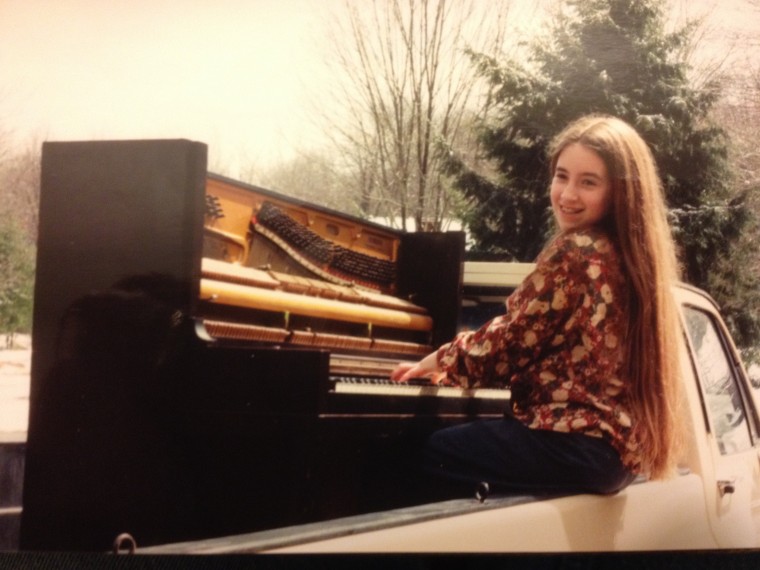
It was a sobering thought, and it put me on alert. I had children too, younger than my friend’s, but they had their vulnerabilities as well–they had desires, and the frustrations to desire. So I hunted around for things to do, clearing a path, smoothing the way toward their futures. My daughter discovered early on that she wanted to play the piano—not a violin, not a keyboard, but a piano. So,well, okay, that was easy enough: we found her a piano.

phpD0PiM9PM


I mean, seriously, I couldn’t even get the instrument out of the truck before she was all over it.

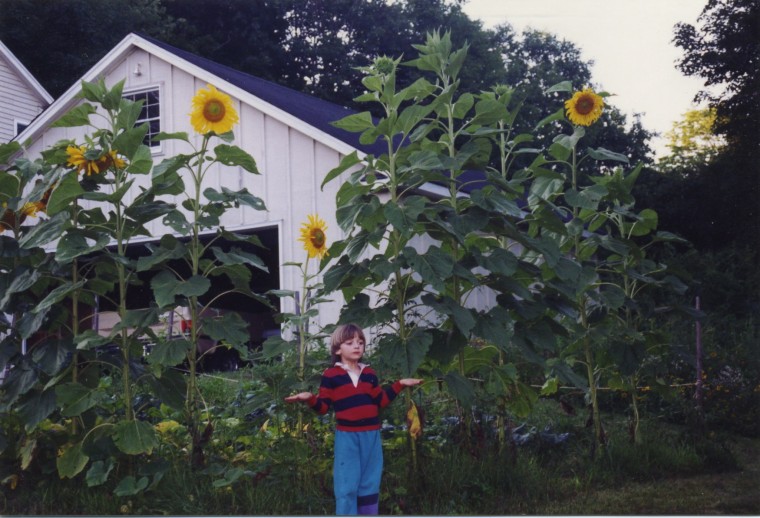
My son, for his part, basically needed room, an exit from the strictures of developed social play into the boundlessness of an unconstructed world.

phpTg5lehPM

From the beginning he has pulled me outdoors, enticed me out from behind my desk and onto frozen dog sleds, into kayaks floating among whales in the Pacific Ocean, on treks in arid Southwestern mountains photographing petroglyphs–and then he has gone to places where I could not follow, so that his safety did not depend on me, but on another father–this one Kenyan, who sat outside his cloth tent at night with a wooden club to whack any marauding hyena that came too close. The lions, apparently, were no problem.

I have wanted to risk all this personal detail here in order to bring each of us, in our minds, personally, onto a certain pathway that leads in the end to M.B. McLatchey’s new book, The Lame God. It’s a book that pretty much requires a personal response from us, because the core of its themes centers around a person: 16-year-old Molly Bish. It is possible that some of you may have heard of her, insofar as her plight unfolded for months in the national news. In fact, it is entirely possible that a few of you may actually have known her, the real Molly Bish—maybe as a high school student, maybe as a neighbor— before in June, 2000, she was abducted from her lifeguard tower at Comins Pond in Warren, MA, and subsequently raped, tortured and then murdered.

Whether McLatchey herself knew Molly is unclear: she does not disclose what, exactly, her relationship to Molly Bish and her family has been. But she does reveal that she has, at a minimum, spoken with the mother, Maggie Bish, to obtain permission to write explicitly about Molly, and about the attending horrors that ensued after she was found to be missing. McLatchey writes in her Introduction “This book is offered in memory of Molly Bish and in homage to her mother, Maggie Bish, who encouraged me to ‘keep talking about this; keep writing.’” McLatchey adds that “The story that this book tells is true. No names have been changed to protect the innocent—the innocent have already seen the face of evil, smelled its breath, learned its customs.”

This is a unique introduction to the poetry. We as readers are explicitly denied the usual aesthetic distances from the events depicted in the stories because the events are not fictionalized. McLatchey’s artistry here is working with brute facts—among which is the troubling recognition that the perpetrator, whoever he is, has not been apprehended. The man is still at large out there. Accordingly, there is no sense of justice in the book, no comfort derived from cosmic symmetries, no vengeance exacted, no eye taken for an eye, no recourse. Just horror.


THE RAPE OF CHRYSSIPUS

She came home bone by bone. First her shin bone, then her skull. In the end, 26 of Molly’s bones came home to us.        –Mother of 16-year-old Molly Bish

For the rape of Chryssipus, King Laius suffered.
The gods saw what he took–
a young boy’s chance

to play in the Nemean Games, to make his offerings
to Zeus, to win his wreath
of wild celery leaves, advance

the Greek way: piety, honor, and strength. He raided
their heaven, not just a small boy’s frame.
Their justice

was what Laius came to dread: a son that would take
his mother to bed,
a champion of the gods, an Oedipus.

We called on the same gods on your behalf, asked
for their twisted best:
disease like a Chimera to eat

your Laius piece by piece; a Harpie, who might wrap
her tongue around his neck
and play his game of breathing

and not-breathing that he made you play.
Medusa’s curse in stone–and a Golden Ram
to put you back together bone by bone.


The quotation alone is hair-raising—though with that said, I am struck by the poet’s lack of overt drama in the poetry that follows. On the one hand we have the sensational, flat enumeration of the number of bones that were, over time, returned one-by one to the grieving mother—and with the manner of that return left unstated. How would you do it? Did they come in a box? Labeled with an evidence tag? Did a policeman ring the doorbell, and hand over her skull? What kind of protocol could even be possible here?

However, before we step out into that emotional darkness, we hear the poet’s measured voice avoiding hysteria by invoking a classical myth, and with it organizing a parallel narrative of divine retribution to help her metabolize her raw feeling. Because contemporary explanations just feel petty, just lame excuses offering a simplistic cause-and-effect model to rationalize the behavior—something like ‘bad parenting creates bad boys’, or these days maybe it is a defective neuron causing the problem. Bullshit. It takes the scale of mythology to begin to convey  the    goliath male evil that descended upon Molly.

The poet’s task is, essentially, to figure out how to express the full weight of the violation without screaming. It is a delicate matter. Often in the book McLatchey combines classical figures with traditional poetic forms to allow us perspective with which to view the scope of violence, and the depth of the insult to Molly and her family. In Little Fits, for instance, the poet composes a sequence of Petrarchan sonnets to organize her thoughts and feelings, and to secure a mental space in which to arrive at insight, emotional clarity, and decision. The formal restraints allow the emotional matter to be pitched very high, but without ever sounding bathetic. And look at the graceful formal movement in this sonnet:


CATHARSIS

A portly man on TV says he’s eating jelly donuts
since his doctor recommended more fruit. My head
tucked beneath your chin, I feel you grin. A welcome joke—
what Aristotle called catharsis: the comedy channel in bed.

A piecemeal purging meant to clear our minds, a chance
to graft, like patchwork, the wreckage of our lives
onto a campy figure, cheer for him; love him for dancing
when the gods single him out, pile on the twisted trials.

As if—for a few moments—we are watching someone else’s
life unfold. Pizza and beer, you my armchair, tucked in our sheets.
As if—for a few moments—we have climbed up from some well
to lounge on sun-baked stone, take in the Dionysian Mysteries:

lore of the vine—seasons, grapes, wine. Nothing ever truly dying.
And us, tender initiates, laughing so hard we’re crying.


Fortunately for the book—possibly for the poet herself—McLatchey moves from her contemplation of the brutish facts of murder, and toward a reprieve, toward a respite that acknowledges other continuities besides those of abiding anguish. Here we find an intimate pair coupled, which is to say, linked in their common association that, for the moment, includes humor and catharsis. Here we are offered an image of mutual purpose, and shared pleasures, as well as their doubled purgation expelling together the poisonous, unacceptable affects.

The purgation signals an emotional transition out of trauma and into sorrow, and to a generalized sense of both vulnerability and promise. The transition is an essential point of the poet’s vision. She discloses that she, too, has children—two sons, we are told—and she has to wonder what she has let herself in for. Having children is a sort of biological vote for continuities, a tacit endorsement of future, continued participation in the social morass. Like it or not, she as a parent is compelled to be party to a world that has its disgusting matters, its truly fearful possibilities, against which she tries to civilize brute desires, and ward off threats to naked innocence. But there is only so much she can do.


Always in the distance
burnt brown combines sweeping up
spools of wheat. My sons sleep
in the back seat—the younger one
bowed over; the other up straight
like a sun-drenched sheaf.

Up ahead, one sheer pool after another
that the heat lays down. Day stars
(the older one calls them) spring up
from the pools and usher us on,
then flicker and steam.
A Dakota we’ve never seen…

I reach back to wake the older one:
solicitude, or a favoritism
that I had thought might pass.
Or a reckoning of our lives
that comes when the light slants
like this, as if we are looking through

more than window glass. I pat
his leg to comfort him, or to bless him,
or to brush some divination off.
But he is already looking out….

from Joseph Dreams Two Dreams   


There is only so much any of us can do, and who knows if it is ever enough?


POSTSCRIPT: It occurs to me that an interesting mirror image to McLatchey’s book —or at least to the events composing the detonating first cause of the book—is a poem found in Frank Bidart’s first poetry collection, Golden State. I’m thinking of Herbert White, which is the first of Bidart’s poetic attempts to inhabit the psyche of various historical persons—Vaslav Nijinsky, for example, the anorectic Ellen West—and convey through them his own matching torments. Herbert White is, or was, a convicted murderer, child molester, and necrophiliac. Bidart’s poem, with its monstrosity, can be read as a companion piece to McLatchey’s traumatic abhorrence. I have written about Herbert White elsewhere: http://www.bradcrenshaw.com/sin-body-frank-bidarts-human-bondage


I Want To Say Something About Pumpkins

Because it’s about that time of year again: I have trays of soil that I have seeded with various kinds of vegetable, summer promises–one of which is pumpkins. There are other things I grow, of course, like the basil and tomatoes I love for the aroma they broadcast into the air around the garden. But I love pumpkins for their magical, transformational energy. I never see a pumpkin on the ground, one of my big ones, without thinking about enchanting it into a coach. I swear, one of these days I’ll do it. To have my giant pumpkin vines dashing out of the garden plot onto the lawn, and down toward the street, is to be invited to a foot race. I want to sprint alongside of them.

phpliNXBYPM

Maria Hummel, in her book House and Fire, has a poem that captures something of the hyperbole of pumpkins–something of that need, once you have really looked at pumpkins, to invent legends about them.

A Thousand Faces

In the creation myths of pumpkin,
bellies grew first, billowing out
before the light, the sea and flowers.

And the bellies commanded the void:
let there be hollows in this darkness
and arches hung with pulp as soft

as the inside of a cheek; let there
be a cathedral for seeds, a favorite
purse in the garden’s green closet.

So the pumpkins grew into portly
multitudes that try not to trumpet
their superiority, each laden

with irreplaceable burdens,
each shape original and derivative,
the plump bulge of matrons,

taut barrels of elderly generals–
and what of that color? Is there
a wish in this world that can blush

as beautifully as the pumpkin?
Gold for secrecy, red for richness
and blessing, a yam paint

mixed with the flush on a girl’s
face the first night she realizes
how to possess her body, then

darkened by rain, autumn, waiting.
The love affairs of pumpkins
are always long, full of slow kisses

and vacations postponed
in favor of staying on the mound,
savoring some peace and quiet

for once, this fragile forever.
In the lame stories of pumpkin
heroes, the bravest line up at dawn

to be carved and shattered for the glory
of harvest, but the waning garden
refuses to cheer for them, or perhaps–

like the sea and its waves, or a mother
watching her sons ride away–it merely
calls too softly for them to hear:

Come back, let me open
for you again, you are mine,
you would never break inside me.
phphfFaC8PM

I couldn’t resist this, it’s one of my favorite pictures: a small, mystical life amid the pile of other lives with their orange glow. The little girl pictured here is now 28 years old, and has grown exquisitely into herself. But the photo reminds me of other of Maria Hummel’s poems. She will break your heart, and then heal it again, with her poems about her very ill infant son. For example:

Strawberries

Today your arm eats strawberries.
Tomorrow birthday cake and toast.
The tubes go in, their liquid clear.

As our life at home grows far
and faint, food becomes a ghost.
Today your arm ate strawberries.

I read you books on dinosaurs,
their lost hungers, fallen bones.
The tubes go in, their liquid clear.

I once loved words, their
fat red flesh, their roar and moan.
Today your arm eats strawberries

and what it tastes can never
be named or held or known.
The tubes go in, thin and clear,

sewing your skin to poles and air.
I once loved a meadow,
its clear little stream, lying there
on my arms, eating strawberries.

Her poem is a villanelle, which she brings off without visible effort. I have to keep going back to re-read it to see how she does it. The formal repetitions and cascading refrains remind me of the kinds of repetitions you find in early children’s books, such as Dr. Seuss, or maybe Sendak’s Chicken Soup With Rice–though here that reminiscence brings little joy, but instead conveys a wistful longing for an innocence neither she nor her son are allowed. Here the form, with its fragile order, must contain all sorrows, and bind the chaos of all fears. It’s a lot to ask. It’s a lot to live through.


Precious Mirror

The poet and artist, Gary Young, was one of the panelists in our recent AWP presentation in Seattle. He has created a PowerPoint presentation illustrating aspects of his translation from the Kanji of Kobun Chino Otogawa–who is perhaps best known in the U.S. as the spiritual guru of the late Steve Jobs. The esteem lavished in Japan upon Otogawa is founded, as you might imagine, less on commercial or media-driven hype, than upon his character as a monk and teacher.

White Pine Press is publishing Gary’s book of translations, along with Otogawa’s kanji.

Precious Mirror – Gary Young

Freedom in Translation: Finding Ourselves a New Poetics

At the recent AWP Conference in Seattle, which convened at the end of February, I moderated a panel on translation as an emblem of poetic freedoms. What follows is the text of my introduction.

I. Our presentation today focuses on two essential concepts:

1. That the act itself of translation chooses among various aspects of sequential cognitive resources—some linguistic, many that are not (What these resources are I will defer for the moment). The crucial feature within translation is its insistence upon a pluralism of linguistic aims.

2.  That the act of translation re-imagines and redefines the mechanisms by which language works: what language is, what are its aspects and features, what are its resources.

II. The first activity will be engaged by my three colleagues–Gary Young, Stephen Haven and James Brasfield– as they each in turn discuss specific features of their work in translating into contemporary American English the poetic works existing in three distinctly non-Western-European languages: Japanese, Chinese, and Ukrainian.

III. My task here is to engage in that second activity: I want to introduce a basis for re-conceiving a poetics that can reflect the range of creative possibilities available to the imagination—because current versions of postmodern poetics constitute a remarkably inappropriate reductivism.

As I’m sure we all know, the core of this poetics inhabits the troubled relationship between the sign and the signified. Its intellectual pedigree runs in generations from Saussure and Nietzsche, to Heidegger, to Derrida and Foucault, and subsequently into the current metamodernists and antihumanists.

The architecture of the argument is benignly simple:

a. Words have no essential relation to their referent. 

b. Rather, meaning is merely a social consensus. 

c. Therefore meaning represents the play of power and money by which social consensus is reached.

d. Ergo, language is the exercise of power, wielded by the wordsmith, to repress other similar exercises.

This entire house of logical cards derives upon that initial proposition: that language is a collection of nouns looking for their referents.

From the point of view of neuroscience, this proposition is untenable for many reasons, but we can start with its entire lack of empirical foundation. What is described by post-modern theorists does not represent the phenomenon they purport to explain. Saussure is the linguistic basis to which the philosophers point for justification, but Saussure was not fluent in, nor ever had even heard a native speaker using, the Indo-European languages from which he derived his theories of linguistics—from which in turn he then generalized to all languages. Accordingly, his conclusions amount to a sophisticated provincialism that, in my belief, has been persuasive largely because it has bolstered the provincialism of Continental and North American theorists.

Postmodern linguistic theory does not survive the translation to non-European languages. For instance, as Steve Haven will be explaining, any given sign in Chinese changes meaning according to which one of the four formal tones of voice in which it is spoken. Chinese does not limit itself to signs and signifieds, but introduces tonal aspects into its linguistic usage—which have remained unconsidered in postmodern theoretical formulations.

I want to propose a different intellectual practice–which will conserve the expectation that a poetics will be based upon features of our language, but that will define those features according to empirical observation and structured inquiry into the phenomena in question. I am, in other words, going to dip into neuroscience to provide an alternative study of the nature of language. *Accordingly, I will start with three observations about language, from the point of view of empirical science:

 a. language is sequential: phoneme follows phoneme, word follows word, sentence follows sentence, paragraph follows paragraph;

 b. it is also patterned:–its features have regular, definable arrangements, which we can group into rules;

c. it is temporal  (It took me 28 seconds to say the words in that sentence.)

These sequential features are not limited to language, but in fact represent a primary inductive category according to which the brain makes cognitive sense of the environment at large. The world is chock full of sequential patterns—the regular and coherent occurrences of sounds, objects, and events to which the brain is sensitive. Some of these are linguistic, but many are not.

a. For instance, laughter is one of the set of complex, nonlinguistic vocalizations that nonetheless communicates a wide range of messages with different meanings. 

b. We likewise find music meaningful,—which also is a structured sequential event–though it, too, is non-linguistic. 

c. Many of us also find meaning in the sensuous sequences of dance–or (to pursue the world of motor movements further) even learning to swing a tennis racket. Dances, procedures for hitting a tennis ball, a golf ball, etc, are each a meaningful set of steps with which motor patterns are engaged. Along these lines we should likewise acknowledge that we walk and run, which are themselves brain-mediated sequential practices…which are non-linguistic. 

d. Finally, we also keep track of time itself, which by definition is sequential—on a daily basis, as well as over prolonged years of developmental, biological time (i.e. circadian, developmental) and worldly time.

What science finds is that there is an interplay among these various neurological sequences. Language is not separate from the rest of cognition, but uses the same underlying neurological mechanisms as other non-linguistic sequential tasks. For instance, aphasic patients are commonly apraxic as well—meaning they are impaired in the production of novel sequential hand and arm movements. Further, the converse is also true: among aphasic patients, the work done to improve non-linguistic motor skills can contribute to improvements in syntax.

So let me conclude here. The translator, having assumed there can be no perfect copy of the original meaning,  is thereby compelled to re-conceive & revalue linguistic resources other than simply matching referents–what the words purportedly mean. The translator is free to look to the interplay among whatever expressive sequences seem called for–whether linguistic (such as hunting for appropriate words), or nonlinguistic, such as establishing a prosody, or working out an appropriate pace of the voice, or introducing tonal features such as sarcasm, or sometimes even environmental noises (The French, for instance,  translate the sound of a barking dog as Woooah Woooah). There is an immensity of sequential sounds, symbols, facial expressions., and physical gestures to sample. The task of the translator thereby opens the inquiry to a range of poetic expression that escapes repressive theory, and finds its limits—insofar as there are any—within the play of imagination itself.

Links to further thoughts and entertainments:

http://www.bradcrenshaw.com/language-isnt-what-you-think